


Fantasy golf scoring converts a professional golfer's real tournament performance into points for a fantasy roster. The most common systems use score to par, per-hole fantasy points, final placement, official prize money, or a combination of hole scoring and tournament bonuses.
The right system depends on whether you are running a one-week golf pool, a daily fantasy contest, a one-and-done competition, or a season-long league. This guide explains every major scoring format, provides worked examples, and gives commissioners rules for cuts, ties, withdrawals, disqualifications, and bonus points.
Quick answer: How does fantasy golf scoring work?
A golfer earns fantasy points from real results such as eagles, birdies, pars, bogeys, making the cut, and finishing near the top of the leaderboard. The points from every active golfer are added to the fantasy team's weekly total. In a season-long league, weekly totals accumulate across the schedule.
Advertisement
| Scoring Format | Primary Measurement | Best For | Winner |
|---|---|---|---|
| Score to par | Actual tournament score relative to par | Simple major pools | Lowest total |
| Per-hole points | Eagles, birdies, pars, and bogeys | DFS and live-scoring leagues | Highest total |
| Finish-position points | Final leaderboard placement | Season-long leagues | Highest total |
| Official money | PGA TOUR prize money earned | One-and-done pools | Highest total |
| Hybrid | Hole points plus cut and finish bonuses | Competitive custom leagues | Highest total |
The Five Main Fantasy Golf Scoring Systems
1. Score-to-Par Scoring
Score-to-par pools use the same numbers displayed on a golf leaderboard. A golfer at 6-under contributes minus six, while a golfer at 3-over contributes plus three. The fantasy team with the lowest combined score wins.
This system is easy to explain because it mirrors tournament scoring, but commissioners must decide how to handle golfers who miss the cut. A player who completes only 36 holes cannot simply be compared with a player who completes 72 holes.
Common solutions include:
- Count only a team's best four or five golfers.
- Assign a fixed missed-cut penalty.
- Give every missed-cut golfer the worst qualifying score plus additional strokes.
- Eliminate teams that do not send a minimum number of golfers to the weekend.
2. Per-Hole Fantasy Points
Per-hole scoring rewards what a golfer does on every hole. Eagles and birdies earn positive points, pars provide a smaller return, and bogeys reduce the total. This creates more live movement than score-to-par because aggressive scoring receives extra value.
A golfer who records six birdies and four bogeys can outscore a golfer who makes two birdies and no bogeys even though both finish the round at 2-under. That makes per-hole scoring particularly useful for DFS and season-long leagues that want activity throughout every round.
3. Finish-Position Points
Placement systems assign a point value to each finishing position. A winner might receive 30 points, second place 20, third place 18, and so on through the top 50. Players who miss the cut usually receive zero.
This format rewards contention and remains easy to aggregate across a season. Its weakness is that Thursday and Friday results have little visible impact until the final leaderboard takes shape.
4. Official-Money Scoring
Official-money pools use a golfer's real tournament earnings as the fantasy score. A selection who earns $1.5 million adds that amount to the manager's season total. One-and-done competitions commonly use this method because it automatically makes majors and Signature Events more valuable.
The tradeoff is that purse size can matter more than golf performance. A fifth-place finish at a major can be worth considerably more than a victory in a smaller event.
5. Hybrid Fantasy Golf Scoring
A hybrid system combines per-hole points with tournament bonuses. Golfers earn points for every eagle, birdie, par, and bogey, then receive additional rewards for making the cut and finishing near the top.
This is the most complete scoring format because it rewards both aggressive daily scoring and four-round tournament success. It also requires the clearest published rules.
Knockdown Fantasy Golf Scoring Rules
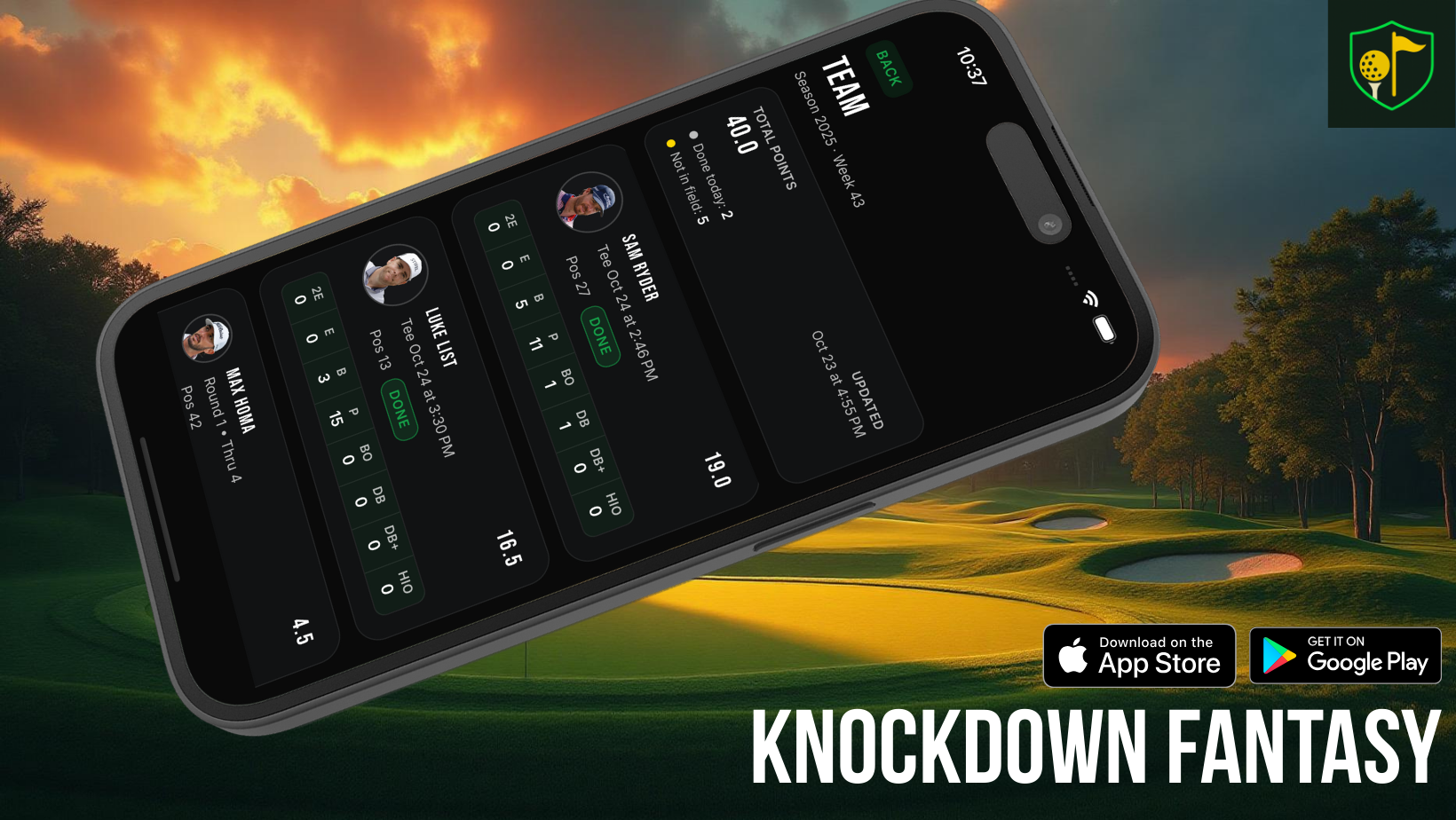
Knockdown uses DraftKings-style per-hole scoring as its base system. Commissioners can also enable customizable cut and finish bonuses. Each active golfer's points contribute to the team's tournament total, and tournament totals accumulate across the fantasy season.
| Hole Result | Fantasy Points |
|---|---|
| Double eagle or better | +13 |
| Eagle | +8 |
| Birdie | +3 |
| Par | +0.5 |
| Bogey | -0.5 |
| Double bogey or worse | -1 |
For the current product rules and league settings, consult the official Knockdown scoring walkthrough.
Worked Fantasy Golf Scoring Example
Suppose a golfer completes an 18-hole round with:
- One eagle
- Four birdies
- Ten pars
- Two bogeys
- One double bogey
The fantasy calculation is:
| Result | Calculation | Points |
|---|---|---|
| Eagle | 1 × 8 | 8 |
| Birdies | 4 × 3 | 12 |
| Pars | 10 × 0.5 | 5 |
| Bogeys | 2 × -0.5 | -1 |
| Double bogey | 1 × -1 | -1 |
| Round total | 23 points |
If the golfer later makes the cut and the league awards a five-point cut bonus, the golfer receives another five points when the cut becomes official. Any finish bonus is added after the final leaderboard is confirmed.
How Cut Bonuses Work
A cut bonus rewards golfers who qualify for the weekend. It increases the value of reliable ball-strikers and gives fantasy managers a clear reason to follow the Friday cut line.
Knockdown's default cut bonus is five points when bonus scoring is enabled, although commissioners can customize the value. A golfer who makes the cut and later receives an MDF designation still earns the cut bonus. Withdrawals and disqualifications do not receive it.
Recommended setting: Use a modest cut bonus between three and six points. A larger bonus can overpower per-hole scoring and make conservative cut-makers too valuable relative to aggressive contenders.
How Finish Bonuses Work
Finish bonuses reward final leaderboard position after the tournament becomes official. Commissioners can assign values to first place through a chosen cutoff such as the top 10, top 25, or top 50.
A simple top-10 table might look like this:
| Finish | Example Bonus |
|---|---|
| 1st | +30 |
| 2nd | +20 |
| 3rd | +18 |
| 4th | +16 |
| 5th | +14 |
| 6th | +12 |
| 7th | +10 |
| 8th | +8 |
| 9th | +6 |
| 10th | +5 |
Keep the gap between first and second large enough to reward victories, but avoid making the winner bonus so dominant that four days of per-hole scoring become irrelevant.
How Fantasy Golf Ties Are Scored
Professional tournaments frequently contain ties, so every placement-based system needs a published rule. The fairest approach is to average the points for the positions occupied by the tied golfers.
For example, imagine two golfers tie for third. If third place earns 18 bonus points and fourth earns 16, add the two values and divide by two:
(18 + 16) ÷ 2 = 17 points for each golfer.
When a tie average produces a decimal, specify whether the league retains the decimal or rounds it. Knockdown rounds tie averages to the nearest whole number. Its finish-bonus rules also include a boundary exception when a tie crosses the final bonus position.
Missed Cuts, Withdrawals, Disqualifications, and MDF
| Status | Recommended Fantasy Treatment |
|---|---|
| Missed cut | Keep points already earned; no weekend points or cut bonus |
| Pre-tournament withdrawal | Allow replacement only if published rules permit and the replacement has not started |
| Mid-tournament withdrawal | Keep completed-hole points; no cut or finish bonus |
| Disqualification | Keep or remove completed points according to the published platform rule; no bonuses |
| MDF | Keep completed-hole points and award the cut bonus if the golfer officially made the cut |
The most important principle is consistency. Do not create a special replacement or penalty after a popular golfer withdraws. The rule must exist before rosters lock.
Single-Tournament vs Season-Long Scoring
Single-Tournament Pools
One-week competitions can emphasize volatility because every roster has only four rounds to separate. Per-hole scoring with meaningful finish bonuses works well when the goal is to keep every birdie relevant.
Score-to-par is better for casual major pools because participants can understand the standings without learning a point table. If you are still building the competition, use the complete guide on how to run a fantasy golf pool.
Season-Long Leagues
Season-long scoring needs balance. If finish bonuses are too large, managers with one tournament winner can erase weeks of steady performance. If hole scoring is too dominant, a golfer can finish outside the top 20 but outscore the champion through birdie volume.
A useful season-long system combines:
- Per-hole scoring for weekly activity
- A moderate cut bonus for four-round reliability
- A descending finish table for tournament contention
- Cumulative weekly totals for the regular season
- A clearly defined playoff format
Recommended Scoring Settings by Group
| Group | Recommended Base | Bonuses | Reason |
|---|---|---|---|
| Casual office pool | Score to par | None | Easy to follow without an app |
| Major championship pool | Per-hole points | Cut and top-10 finish | Keeps all four days active |
| Season-long friend league | Per-hole points | Cut and top-50 finish | Balances volume, consistency, and winning |
| One-and-done | Official money | None | Creates schedule and purse strategy |
| DFS-style private contest | Per-hole points | Scoring streaks or finish bonuses | Rewards birdies and ceiling |
Fantasy Golf Scoring Mistakes to Avoid
- Overweighting one tournament win: The season should not be decided by one result unless that is the intended format.
- Using an undefined missed-cut penalty: Every team must know the consequence before selecting golfers.
- Ignoring ties: Placement points become unfair when tied golfers receive arbitrary values.
- Adding too many bonuses: Members should be able to understand why the standings changed.
- Scoring bench players accidentally: Clearly distinguish active golfers from reserves.
- Finalizing too early: Wait until the official tournament leaderboard includes scoring corrections.
Frequently Asked Questions
What is the standard fantasy golf scoring system?
There is no universal standard. DFS contests commonly award per-hole points, simple pools use score to par, and one-and-done leagues often use official prize money. Knockdown uses per-hole points with optional cut and finish bonuses.
Do fantasy golfers get points after missing the cut?
No new hole points are earned after a missed cut because the golfer does not play the weekend. Points already earned on Thursday and Friday remain unless the pool rules state otherwise.
How many points is a birdie in fantasy golf?
In DraftKings-style scoring and Knockdown, a birdie is worth three points. Other platforms can use different values, so always check the league rules.
How many points is an eagle in fantasy golf?
An eagle is worth eight points in the Knockdown and DraftKings-style base system. A double eagle or better is worth 13.
Do tied golfers receive the same finish bonus?
Yes, but the shared value should be calculated by averaging the bonuses for the positions occupied by the tie. Two golfers tied for third split the third- and fourth-place point values equally.
What is the best fantasy golf scoring system?
Per-hole points with moderate cut and finish bonuses provides the most complete experience for competitive leagues. Score-to-par is the easiest system for casual pools, while official-money scoring is best suited to one-and-done.
Build a League With Automatic Fantasy Golf Scoring
The best scoring system is one your members understand and your commissioner can administer consistently. Publish the table before the draft, test a sample round, and avoid changing point values after the season begins.
Start a league with Knockdown Fantasy to automate per-hole scoring, cut bonuses, finish bonuses, standings, drafts, and roster management. If the group is not set up yet, continue with our guide on how to start a fantasy golf league.